Blocking Mats for Crochet Blanket: 4 Best Picks Compared (2026)
Comparing four blocking mats for crochet blanket projects, with sizing, pin count, grid design and care notes to help you pick the right set for your throw.
 By Claire Whitaker
Updated November 11, 2026
 By Claire Whitaker
Updated November 2026
Blocking mats for crochet blanket projects make a real difference to the finished look of a throw. Blankets are large, and they are prone to uneven edges, curled corners and stitches that never quite settle into place. A good set of interlocking foam mats gives you a flat, measurable surface, and a pin system to hold the fabric exactly where you want it while it dries. This guide compares four sets with different piece counts, grid styles and pin counts, so you can match a mat to the size of blanket you plan to make. The criteria we used were grid accuracy, how well the tiles lock together, pin count and pin quality, how the foam handles moisture, and how much flat space each set covers.
Our top picks at a glance
- 1TOP CHOICEBest overall9 Pack Blocking Mats for Knitting & Crochet Projects 12" x 12" | WithView on Amazon
- 2
 Best for large blanketsCraftyManor 9 PCS Blocking Mats for Knitting & Crochet Projects, CrochView on Amazon
- 3
 Best for interlocking flexibilityELSIER Interlocking Blocking Mats, 12"x12", 9 Pack | Knitting BlockingView on Amazon
- 4
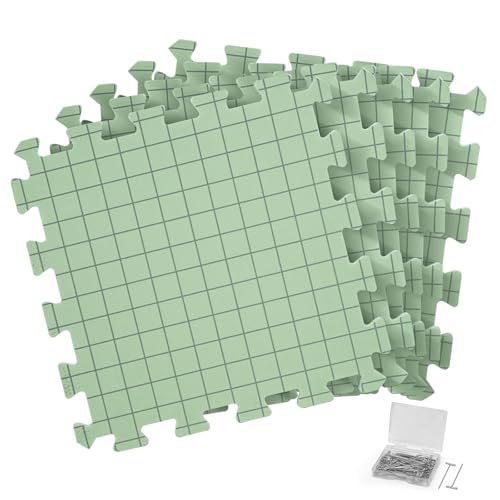 Best budget pickCraftyManor 5 PCS Blocking Mats for Knitting & Crochet Projects, CrochView on Amazon
Our Top Picks
| Product | Best for | Key feature |
|---|---|---|
| 9 Pack Blocking Mats for Knitting & Crochet Projects 12″ x 12″ | Most crocheters making full-size blankets | Nine 12″ tiles with 50 T-pins and an aligned gray grid |
| CraftyManor 9 PCS Blocking Mats (Green 9PCS) | Large throws and lap blankets | Nine-piece green set with 50 T-pins |
| ELSIER Interlocking Blocking Mats, 12″x12″, 9 Pack | Irregular or oversized shapes | Interlocking edges for a flexible footprint |
| CraftyManor 5 PCS Blocking Mats (Green 5PCS) | Baby blankets, shawls and small projects | Compact five-piece set with 50 T-pins |
9 Pack Blocking Mats for Knitting & Crochet Projects 12″ x 12″ | With 50 T-Pins, Gray Aligned Grid Knitting Blocking Mats, Foam Board Design, Knitting Board, Water & Heat Resistant
9 Pack Blocking Mats for Knitting & Crochet Projects 12" x 12" | With 50 T-Pins, Gray Aligned Grid Knitting Blocking Mats, Foam Board Design, Knitting Board, Water & Heat Resistant
Best for: Most crocheters making full-size blankets who want a balanced, all-purpose set.
This set suits crocheters who work in worsted or chunky acrylic and need a surface large enough for a standard throw. The gray grid is aligned, so you can measure rows and columns against the tile lines as you pin.
Key specs
- Nine tiles measuring 12″ x 12″ each
- 50 T-pins included
- Foam board construction with an aligned grid
- Listed as water and heat resistant
Pros
- Nine tiles cover a generous working area for most blanket sizes
- Aligned grid makes measuring and squaring edges straightforward
- Pin count is enough for a full blanket perimeter
Cons
- Gray tiles show lint and fiber more readily than darker colors
- Pins can be difficult to remove from dense foam if pushed in at an angle
Bottom line: A strong default choice for crocheters who want one set that handles most blanket sizes without much fuss.
View on AmazonCraftyManor 9 PCS Blocking Mats for Knitting & Crochet Projects, Crochet Blocking Mat with 50 T- Pins, Knitting Board and Pins (Green 9PCS)
CraftyManor 9 PCS Blocking Mats for Knitting & Crochet Projects, Crochet Blocking Mat with 50 T- Pins, Knitting Board and Pins (Green 9PCS)
Best for: Large throws and lap blankets that need a big, flat workspace.
This is the same nine-piece footprint as the gray set, in green. It suits makers who prefer a higher-contrast surface, since colored stitches often read more clearly against green than against gray.
Key specs
- Nine-piece set
- 50 T-pins included
- Green foam tiles
Pros
- Nine tiles give plenty of room for large blankets
- Green surface offers good contrast with light-colored yarn
- Includes a full pin set for securing edges
Cons
- Dark colored yarn can be harder to see against the green
- Owners often report that tiles can shift slightly if not locked firmly
Bottom line: Best for crocheters blocking large blankets who want the same capacity as a nine-tile set with a different color.
View on AmazonELSIER Interlocking Blocking Mats, 12″x12″, 9 Pack | Knitting Blocking Mats, Crochet Blocking Board, For Knitting & Crochet Projects
ELSIER Interlocking Blocking Mats, 12"x12", 9 Pack | Knitting Blocking Mats, Crochet Blocking Board, For Knitting & Crochet Projects
Best for: Irregular or oversized shapes that do not fit a rectangular footprint neatly.
Interlocking tiles let you build a shape that matches your project, which helps with granny squares, large motifs and blankets with non-standard dimensions.
Key specs
- Nine tiles measuring 12″ x 12″
- Interlocking edges
- Designed for knitting and crochet blocking
Pros
- Interlocking edges let you adjust the board to unusual shapes
- Tiles are sized for even, repeatable grid spacing
- Suitable for both knitting and crochet
Cons
- Interlocking joints can separate slightly under heavy wet fabric
- Owners often mention that the interlocks need careful alignment on first assembly
Bottom line: Pick this set if your blanket is not a simple rectangle or if you block motifs that need a custom footprint.
View on AmazonCraftyManor 5 PCS Blocking Mats for Knitting & Crochet Projects, Crochet Blocking Mat with 50 T- Pins, Knitting Board and Pins (Green 5PCS)
CraftyManor 5 PCS Blocking Mats for Knitting & Crochet Projects, Crochet Blocking Mat with 50 T- Pins, Knitting Board and Pins (Green 5PCS)
Best for: Baby blankets, shawls and smaller projects where a full nine-tile set is more than you need.
A five-piece set covers a smaller area, which makes it easier to store and quicker to set up. It is a sensible starting point for crocheters who block mostly smaller pieces.
Key specs
- Five-piece set
- 50 T-pins included
- Green foam tiles
Pros
- Compact footprint fits on a small table or shelf
- Same pin count as the larger set, so pinning density is generous
- Lower piece count makes setup faster
Cons
- Five tiles are not enough for a full-size adult blanket in one piece
- Limited surface means you may need to block in sections
Bottom line: A good fit for baby blankets, shawls and small projects, or as a second set alongside a larger board.
View on AmazonBuying Guide
Tile size and total coverage
Measure your finished blanket before you choose a set. Twelve-inch tiles make a 36″ x 36″ square with nine pieces, which handles many lap and throw sizes. Five tiles give a smaller working area suited to baby blankets and shawls. If your blanket is larger than your total mat area, plan to block in sections and align each section against the grid.
Good picks for this: 9 Pack Blocking Mats for Knitting & Crochet Projects 12″ x 12″; CraftyManor 9 PCS Blocking Mats (Green 9PCS)
Grid accuracy and markings
An aligned grid lets you measure stitch and row counts against the surface, which is helpful when a pattern gives finished dimensions. Check whether the lines are printed clearly and whether they line up across tile joints. Lines that drift between tiles make it harder to square corners.
Good picks for this: 9 Pack Blocking Mats for Knitting & Crochet Projects 12″ x 12″; ELSIER Interlocking Blocking Mats, 12″x12″, 9 Pack
Interlocking design
Interlocking tiles let you extend or reshape the board. Look for edges that click or lock with a firm fit, and check that the joints do not pull apart when wet fabric is pinned to them. Non-interlocking tiles can work well if you always block the same shape, but they offer less flexibility.
Good picks for this: ELSIER Interlocking Blocking Mats, 12″x12″, 9 Pack; CraftyManor 9 PCS Blocking Mats (Green 9PCS)
Pin count and pin quality
Blocking a blanket uses many pins. A set with 50 T-pins gives enough to secure a full perimeter and interior points on a large piece. Check that pins are rustproof, have a sturdy head and a fine enough shaft to avoid leaving holes in delicate yarn. Owners often report that longer pins are easier to remove from thick foam.
Good picks for this: 9 Pack Blocking Mats for Knitting & Crochet Projects 12″ x 12″; CraftyManor 5 PCS Blocking Mats (Green 5PCS)
Foam density and moisture handling
Blocking involves wet fabric, so the foam must resist swelling and staining. Products described as water and heat resistant are a useful starting point. Dense foam holds pins more firmly, while softer foam can let pins wobble. Dry tiles fully after each use to prevent odor or mildew, and keep them away from direct heat.
Good picks for this: 9 Pack Blocking Mats for Knitting & Crochet Projects 12″ x 12″; CraftyManor 9 PCS Blocking Mats (Green 9PCS)
Color and visibility
Mat color affects how easily you can see stitch definition and stray fibers. Light yarns read clearly on darker surfaces, and dark yarns often show better on lighter ones. Gray and green are both common choices. Pick a color that gives your main yarn the most contrast.
Good picks for this: CraftyManor 9 PCS Blocking Mats (Green 9PCS); CraftyManor 5 PCS Blocking Mats (Green 5PCS)
Storage and portability
Blocking mats take up floor or table space while in use and need a place when stored. A five-piece set is easier to tuck away than a nine-piece set. If you work on a dining table, consider how long you can leave the board in place before dinner. Store mats flat or upright, away from humidity, so they stay straight.
Good picks for this: CraftyManor 5 PCS Blocking Mats (Green 5PCS); ELSIER Interlocking Blocking Mats, 12″x12″, 9 Pack
FAQ
How many blocking mat tiles do I need for a crochet blanket?
Nine 12-inch tiles cover a 36-inch square, which handles most lap blankets and many standard throws. For larger blankets, block in sections and align each section to the grid, or pick a larger total footprint. Five tiles are better suited to baby blankets, shawls and smaller pieces.
Can I use blocking mats for both knitting and crochet?
Yes. Most of these sets are described for both knitting and crochet projects. The pins and foam work the same way for either craft, so one set can serve both.
What size pins should I use for blocking?
T-pins are the most common choice for blocking. Pick pins with fine shafts so they do not leave large holes in acrylic or cotton yarn, and sturdy heads that you can grip easily. Owners often report that rustproof pins hold up better after repeated wet blocking.
Will blocking mats damage my yarn?
Blocking mats are designed to hold fabric in shape while it dries. Use gentle pressure when pinning, avoid stretching past the natural shape of the stitches, and check the yarn label for care instructions. Acrylic yarn can be blocked with moisture, but heat settings and steam need caution, so check what the yarn manufacturer recommends.
How do I clean blocking mats?
Wipe the foam with a damp cloth to remove lint and dust, then let it air dry completely. Avoid soaking foam tiles for long periods, since that can weaken the joints over time. Store them dry to prevent odor or mildew.
Are interlocking mats better than standard tiles?
Interlocking tiles offer more flexibility because you can change the shape of the board. Standard tiles can be just as accurate if you always block the same rectangle. Choose interlocking if your projects vary in shape or size.
Can I block a crochet blanket without a mat?
You can block on a bed, a dining table covered with towels or a large flat surface. Without a grid and pins, though, it is harder to achieve even edges and square corners. Mats make the process more repeatable, especially for projects with specific finished dimensions.
Conclusion
For most crocheters, the nine-piece 12-inch set with 50 T-pins is the most practical starting point, because it covers a large area and includes enough pins for a full blanket. If you want the same size in a different color, the green nine-piece option is a good alternative. Interlocking tiles suit irregular shapes and motifs, while the five-piece green set works best for baby blankets, shawls and small pieces. Match the mat to the largest project you expect to block, then check pin quality and foam density before you buy.
Sources
- Safety guidance on foam products and small parts that can be relevant to home craft materials (cpsc.gov)
- Workplace guidance on ergonomics and working posture for long periods of seated handwork (osha.gov)
- General guidance on home cleaning, moisture control and reducing mold risk in indoor spaces (cdc.gov)
Related reading
- Blocking Mats for Crochet: 5 Best Picks for Every Need (2026)
- 4 Best Blocking Mats for Knitting Projects in 2026
- 3 Best Blocking Mats for Knitters Compared (2026)
- Blocking Crochet Acrylic Yarn: 5 Best Picks Compared (2026)
About Claire Whitaker
Claire Whitaker is part of our editorial team and reviews and edits our knitting guides, checking product details against manufacturer specifications and owner feedback.
About the author
Claire Whitaker writes reviews and buying guides for Passion Knit.