6 Best Knitiq Blocking Mats for Knitting (2026)
Compare six knitiq blocking mats for knitting by size, grid type, pin count and storage, with pros, cons and buying tips to find the right set for your projects
 By Miles Sinclair
Updated November 23, 2026
 By Miles Sinclair
Updated November 2026
Choosing among knitiq blocking mats for knitting can be confusing, because the sets look similar at first glance but differ in tile size, grid markings, edge design and how many pins come in the box. This list compares six interlocking blocking mat kits sold under the KnitIQ name and similar brands. Our selection criteria were product specifications stated in each listing, brand reputation, and patterns that owners commonly mention in feedback, such as how well tiles hold their shape, whether the grid lines are easy to read, and whether the included pins are long enough for thick yarns. We did not test these products ourselves.
Our top picks at a glance
- 1TOP CHOICEBest overallKnitIQ Standard 9-pc Set of Blocking Mats for Knitting & CrochetView on Amazon
- 2
 TOP CHOICEBest for metric knittersKnitIQ Centimeter Knitting Block MatView on Amazon
- 3
 TOP CHOICEBest for lace and crochetSvartur Interlocking Blocking Mat for Knitting and Crochet ProjectsView on Amazon
- 4
 Best for large sweatersOpstin Knitting Blocking Mats and Pins, Interlocking Blocking BoardsView on Amazon
- 5
 Best budget pickMr. Pen Blocking Mats for Knitting & Crochet Projects, 12" x 12"View on Amazon
- 6
 Best for pin-heavy projects9 Packs Blocking Mats for Knitting with Blocking Comb PinsView on Amazon
Our Top Picks
Quick Comparison
| Product | Best for | Key feature |
|---|---|---|
| KnitIQ Standard 9-pc Set of Blocking Mats | General knitting and crochet | Nine boards with gridlines plus 100 T-pins |
| KnitIQ Centimeter Knitting Block Mat | Metric measurements | Grid marked in centimeters |
| Svartur Interlocking Blocking Mat | Lace and crochet | Comb pins with radial grid lines |
| Opstin Knitting Blocking Mats and Pins | Large and thick pieces | 0.75-inch extra-thick tiles and 150 T-pins |
| Mr. Pen Blocking Mats for Knitting & Crochet | Small projects and starter kits | 12 x 12 inch tiles, 9-pack with 150 pins |
| 9 Packs Blocking Mats for Knitting | Pin-intensive shaping | 20 comb pins and 100 T-pins with radial grid |
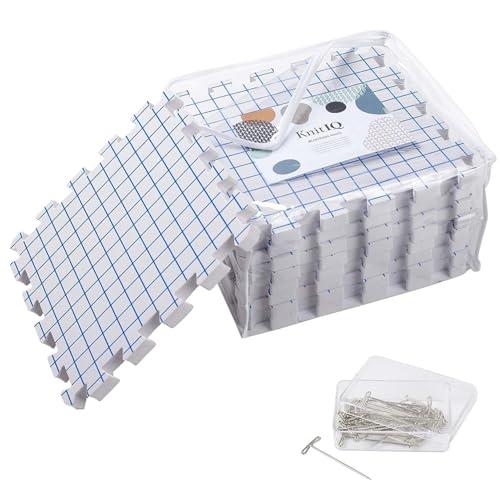
KnitIQ Standard 9-pc Set of Blocking Mats for Knitting & Crochet
KnitIQ Standard 9-pc Set of Blocking Mats for Knitting & Crochet, Clear Bag | Blocking Mat Kit for Knitting, Crochet, Lace & Needlepoint: 9 Blocking Boards (w/ Gridlines) + 100 T-Pins + Clear Storage
Best for: General knitting and crochet with a single, versatile set
This set suits knitters who want one kit that handles scarves, hats, sweaters and small blankets. Nine interlocking boards give enough room for a medium sweater front or back, and the clear storage bag keeps tiles and pins together between sessions.
Key specs
- Nine blocking boards with gridlines
- 100 T-pins included
- Clear storage bag
Pros
- Versatile for knitting, crochet, lace and needlepoint
- Gridlines help with measuring and keeping edges square
- Storage bag keeps the set compact
Cons
- Tile edges can be less secure than heavier-duty designs when pinned hard
- Limited to the included pin count for very large projects
Bottom line: A strong first choice for knitters who want an all-purpose set and do not need specialty grids.
View on AmazonKnitIQ Centimeter Knitting Block Mat
KnitIQ Centimeter Knitting Block Mat – 9 Extra Thick Block Mats with Grids Measure in CM, 100 T-Pins and Storage Bag for Knitting or Crochet
Best for: Metric measurements and pattern work in centimeters
Knitters who follow European or metric patterns will find the centimeter grid easier to use than inch markings. The nine extra-thick tiles and included pins make this a complete working setup.
Key specs
- Nine extra-thick block mats
- Grid measured in centimeters
- 100 T-pins and storage bag included
Pros
- Metric grid matches many international patterns
- Extra-thick tiles resist pin pressure well
- Complete kit with pins and storage
Cons
- Inch-based knitters may need to convert measurements
- Heavier than thin foam options, which matters for portability
Bottom line: Best for knitters who work in metric and want a sturdy, complete set.
View on AmazonSvartur Interlocking Blocking Mat for Knitting and Crochet Projects
Svartur Interlocking Blocking Mat for Knitting and Crochet Projects, 9 Pack Knitting Blocking Mats with Blocking Comb Pins, T-pins, Crochet Blocking Board, Knitting Mat with Grid Line, Storage Bag
Best for: Lace shawls and crochet pieces that need precise radial shaping
Lace knitters often need to open out points and scallops, and radial grid lines help with that. The comb pins are useful for holding delicate edges without stretching them out of shape.
Key specs
- Nine-pack interlocking tiles
- Grid lines for knitting and crochet
- Blocking comb pins, T-pins and storage bag included
Pros
- Radial lines suit lace and shawl shaping
- Comb pins help with edge-heavy pieces
- Includes a storage bag
Cons
- Grid density may feel busy for simple garments
- Pin types are mixed, so sorting is needed before use
Bottom line: A good match for lace and crochet knitters who value shaping tools as much as flat space.
View on AmazonOpstin Knitting Blocking Mats and Pins, Interlocking Blocking Boards
Opstin Knitting Blocking Mats and Pins, Interlocking Blocking Boards for Crochet Projects 0.75'' Extra Thick Blocking Mats with 150 T-Pins and Storage Bag
Best for: Large sweaters, blankets and thick yarns
The 0.75-inch thickness is the main draw here. Thicker tiles hold pins firmly, which helps when you are pinning heavy wool or a large garment that needs to stay flat overnight.
Key specs
- Extra-thick interlocking tiles (0.75 inch)
- 150 T-pins
- Storage bag included
Pros
- Thick tiles hold pins firmly
- Large pin count supports big pieces
- Good for blankets and bulky yarns
Cons
- Thick tiles are bulkier to store
- Pins may be shorter than some knitters prefer for very thick fabric
Bottom line: Best for knitters who block large or bulky pieces and have room to store a thicker set.
View on AmazonMr. Pen Blocking Mats for Knitting & Crochet Projects, 12″ x 12″
Mr. Pen- Blocking Mats for Knitting & Crochet Projects, 12" x 12" | 9 Pack with 150 pcs T-Pins, Gray Aligned Grid Knitting Blocking Mats and Pins, Water & Heat Resistant
Best for: Small projects, beginners and a lower-commitment starter setup
This nine-pack with a large pin count suits knitters who are just building a blocking kit or who mostly make hats, cowls and socks. The 12 x 12 inch tiles are easy to handle and rearrange.
Key specs
- 12 x 12 inch tiles, nine-pack
- 150 T-pins
- Gray aligned grid
Pros
- Good pin count for the price tier of a starter set
- Aligned grid makes measuring straightforward
- Manageable tile size for small projects
Cons
- Tiles may be too small for large sweaters without many extra boards
- Owners sometimes mention that edges may need extra pins for firm hold
Bottom line: A sensible choice for beginners or anyone with limited space who mainly blocks smaller items.
View on Amazon9 Packs Blocking Mats for Knitting with Blocking Comb Pins
9 Packs Blocking Mats for Knitting with 20 Blocking Comb Pins,100 T-Pins | Extra Thick Knitting Blocking Mats with Grid Radial Lines,Crochet Blocking Board for Needlepoint or Crochet with Storage Bag
Best for: Projects that need many pins and fine shaping
The combination of 20 comb pins and 100 T-pins gives you flexibility for scalloped edges, lace borders and textured stitches that need individual pinning. The radial grid helps with symmetry.
Key specs
- Nine-pack extra-thick tiles
- 20 blocking comb pins and 100 T-pins
- Radial grid lines and storage bag
Pros
- Comb pins suit lace and edge work
- Radial grid supports symmetrical shaping
- Extra-thick tiles for secure pinning
Cons
- Radial lines can be distracting on plain stockinette pieces
- Pin count split between two types may require sorting
Bottom line: Ideal for knitters who regularly pin lace, borders or intricate shapes and want extra pin types on hand.
View on AmazonBuying Guide
Tile Size and Layout
Most interlocking sets use tiles between 9 and 12 inches on a side. Larger tiles let you block a full sweater front in fewer moves, while smaller tiles are easier to store and rearrange. Measure your largest finished piece before buying, and plan for a layout that gives at least two inches of clearance around the edges.
Good picks for this: Opstin Knitting Blocking Mats and Pins, Mr. Pen Blocking Mats
Grid Markings: Inches or Centimeters
Check whether the grid is printed in inches or centimeters. If your patterns list measurements in one system, a matching grid saves conversion errors. Radial lines are helpful for lace and circular shapes, while plain square grids work better for garments.
Good picks for this: KnitIQ Centimeter Knitting Block Mat, Svartur Interlocking Blocking Mat
Thickness and Pin Hold
Tile thickness affects how well pins stay put. Thicker boards generally hold pins more firmly, which matters for heavy wool and large garments. Thin foam tiles are lighter but may allow pins to shift under tension.
Good picks for this: Opstin Knitting Blocking Mats and Pins, 9 Packs Blocking Mats for Knitting
Pin Count and Pin Types
Count the pins you will need before buying. A typical sweater can use 40 to 80 pins, so a set with 100 or more gives comfortable room. Comb pins and T-pins serve different purposes, so a set that includes both can cover more techniques.
Good picks for this: 9 Packs Blocking Mats for Knitting, KnitIQ Standard 9-pc Set
Use Case: Knitting, Crochet or Both
Some sets are marketed for knitting and crochet together, while others focus on one craft. If you crochet motifs or lace, look for a grid that suits small repeating shapes. Mixed-use sets are a practical choice for most knitters who also crochet.
Good picks for this: KnitIQ Standard 9-pc Set, Svartur Interlocking Blocking Mat
Durability and Materials
Look at how the tiles are described: water resistance, heat resistance and edge design all affect how long a set lasts. Owners often report that edges of interlocking tiles wear first, so check that the connectors feel secure when you build your layout.
Good picks for this: Mr. Pen Blocking Mats for Knitting & Crochet, KnitIQ Centimeter Knitting Block Mat
Storage and Portability
A storage bag keeps tiles and pins together and prevents lost pieces. If you travel to knitting groups or classes, consider the weight and number of tiles. Smaller sets stack more easily in a bag or bin.
Good picks for this: Mr. Pen Blocking Mats for Knitting & Crochet, KnitIQ Standard 9-pc Set
FAQ
Are knitiq blocking mats for knitting suitable for crochet too?
Many of the sets on this list are marketed for both knitting and crochet, and their gridlines and tile layouts work for either craft. Check the listing for the exact use cases stated, since some kits focus on lace or needlepoint.
How many tiles do I need for a sweater?
A medium adult sweater usually fits on about four to six 12-inch tiles when laid flat, depending on the design. Larger garments may need the full nine-tile set. Lay your piece out first to count the boards you need.
What is the difference between T-pins and blocking comb pins?
T-pins are straight pins with a flat head that work well for general edges and seams. Blocking comb pins have a row of prongs that grip several stitches at once, which helps with lace and delicate edges.
Can I use foam mats with a knitting pattern that lists metric measurements?
Yes, but measure carefully. If the pattern uses centimeters, a centimeter-marked grid saves conversion. Otherwise, use a ruler or measuring tape to check dimensions against the pattern schematic.
How often should I replace my blocking mats?
There is no fixed lifespan. Replace tiles when edges no longer connect securely, when the surface is heavily dented so pins no longer hold, or when grid lines have worn away and become hard to read.
Do I need a storage bag?
A storage bag is useful for keeping tiles and pins together, especially if your set includes many small pieces. It also protects the grid surface from dust between sessions.
Conclusion
For a versatile, all-around set, the KnitIQ Standard 9-pc kit is a sensible starting point. Metric knitters will find the KnitIQ Centimeter mat more useful, while lace and crochet work benefits from the Svartur set with its radial grid. Knitters blocking large or bulky pieces should consider the thicker Opstin set, and beginners working on small projects may prefer the Mr. Pen nine-pack. If you pin many lace edges, the 9 Packs set with comb pins adds useful flexibility. Match the tile size, grid system and pin count to the projects you make most often.
Sources
- Product safety guidance for household items and craft materials (cpsc.gov)
- Workplace ergonomics and tool-handling recommendations relevant to repetitive hand tasks (osha.gov)
- Measurement standards and metric unit conversion references (nist.gov)
Related reading
- Knitting Blocking Mats and Pins: A Step-by-Step Guide for Knitters
- Knitiq Double-Sided Blocking Mats: 5 Best Picks Compared (2026)
- Blocking Mats and Pins for Knitting: 6 Best Picks Compared (2026)
- Best Knitting Blocking Mats: 4 Options and How to Choose One
- 7 Best Blocking Mats for Knitting UK: Our Picks Compared (2026)
- 7 Best Blocking Mats for Knitting Canada Knitters Use in 2026
- 6 Best Knitters Pride Blocking Mats for Knitting Projects (2026)
- 6 Best Knitpro Lace Blocking Mats for Lace Knitting (2026)
About Miles Sinclair
Miles Sinclair is part of our editorial team and reviews and edits our knitting guides, checking product details against manufacturer specifications and owner feedback.
About the author
Miles Sinclair writes reviews and buying guides for Passion Knit.